

Alessandro Gomez, Ph.D
Professor of
Mechanical Engineering
Director of the
Yale Center for
Combustion Studies
Yale University
P.O. Box 208286
New Haven, CT 06520-8286
USA
Phone: 203.432.4384
Fax 203.432.7654
alessandro.gomez@yale.edu
YALE SCHOOL OF ENGINEERING & APPLIED SCIENCE
|
RESEARCH
A common thread throughout our research is striving to have a measure of control in the challenging technical problems we tackle. To the extent possible we devise well-defined experiments to sort out cause-and-effect relationships and draw unambiguous conclusions. We apply this approach to two primary research areas: combustion and electrospray applications. Our activity was funded by the National Science Foundation, the Army Research Office and the Air Force Office of Scientific Research. We also devote some internal seed funds to exploratory projects. Below is a brief summary of some research topic. Details are in archived publications.
Combustion in Well-Defined and Well-Controlled Systems
Research is focused on soot in (high-pressure) flames and turbulent combustion. To achieve the necessary control in these disparate systems, we rely on the counterflow flame configuration with which we have had a “love affair” for a long time. Research on soot formation exploits the unique advantages of the counterflow diffusion flames to probe soot behavior with adequate resolution, even in high-pressure flames. Research on counterflow turbulent flames is finalized at synthesizing key aspects of turbulent combustion under both nonpremixed and premixed conditions, which should provide dramatic advantages in concurrent computational modeling.
Soot Studies in High-Pressure Counterflow Diffusion Flames (NSF sponsored)
An experimental system was designed to investigate soot formation in counterflow diffusion flames at elevated pressures, up to 40 atm. One of the main difficulties of studying soot formation under these conditions is that sooting tendency is exacerbated at high pressures, with experimental complications that make it challenging to perform fundamental studies. A counterflow configuration is advantageous in this respect for the following reasons: the unparalleled level of control that it provides on the soot formation process, the suppression of buoyancy instabilities that typically plague co-flow flames at high pressures, and the opportunity of modeling the system in subsequent studies as one-dimensional, which is critical for systems with a very large chemical mechanism, as required by soot modeling. The flame is operated as a reactor with constant temperature-convective time history in which the effect of pressure and diffusion are isolated. Furthermore, we developed probing techniques that allow us to resolve the structure of even high-pressure flames with good spatial resolution and with a detailed chemical characterization of species consisting of up to two aromatic rings. A detailed compilation of boundary conditions and of the species profiles is available here for use by modelers.
Under ARO sponsorship, in a recently completed study the focus was shifted to partially premixed flames and low temperature combustion: the rationale for choosing counterflow partially premixed flames is that they capture some key features of soot formation in engines. We provide here a glimpse of the level of control we exercised on these flames. We started off by perturbing an atmospheric-pressure ethylene diffusion flame, progressively adding oxygen in the fuel stream, while holding constant peak temperature and stoichiometric mixture fraction. The resulting partially premixed flames presented a well-defined double structure, with a (lightly) sooting region sandwiched between a premixed flame component and a diffusion flame one, both flames being coupled thermally and chemically. Our study compared various flames with a constant temperature-time history, which evidenced unequivocally cause-effect relationships in the path to soot formation. Such flames were systematically studied by measuring temperature and species concentrations up to 3-ring aromatics for subsequent comparison with simple, mostly one-dimensional, computational modeling with well-specified boundary conditions, using detailed chemical kinetics, including soot precursors.
 |
Top: left- schematic of the high-pressure chamber; middle- picture of a 2.5MPa C2H4/N2/O2 counterflow diffusion flame, with sampling probe visible in the bottom half; right- schematic of top half of the converging-nozzle burner used for high-pressure studies. Bottom: incipient soot morphology under TEM. |
 |
Highly Turbulent Counterflow Flames: a Laboratory-Scale Benchmark for Practical
Systems (NSF sponsored)
Highly turbulent counterflow flames are stabilized as a very useful benchmark of complexity intermediate between laminar flames and practical systems. By operating in a turbulent Reynolds number regime of relevance to practical systems such as gas turbines and internal combustion engines, these flames retain the interaction of turbulence and chemistry of such environments, but offer several advantages including: a) the achievement of high Reynolds numbers without pilot flames, which is particularly advantageous from a modeling standpoint; b) control of the transition from stable flames to local extinction/reignition conditions; c) compactness of the domain by comparison with jet flames, with obvious advantages from both a diagnostic and, especially, a computational viewpoint; and d) the reduction or, altogether, elimination of soot formation, thanks to the high strain rates and low residence times of such a system, and the establishment of conditions of large stoichiometric mixture fraction, as required for robust flame stabilization. The aim of the current research is to probe the behavior of nonpremixed and premixed turbulent flames under conditions ranging from vigorous burning to local extinction. In addition to probing the phenomenology in all of these regimes, we are developing an experimental data base for the validation of CFD models pursued in other groups with which we collaborate. The program is leveraged with the participation of the group of Dr. Jonathan Frank (Sandia National Laboratories) for the implementation of
state-of-the-art laser diagnostic techniques.
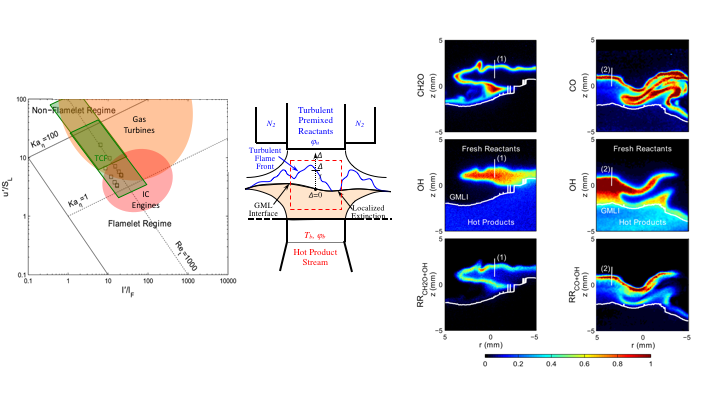 |
Left: Regime diagram showing domains of engines and of the turbulent counterflow system (green) in terms of nondimensional velocity scale versus length scale. Examples of flame front structure from multiple planar laser induced fluorescence techniques (OH, CO, HCHO) applied simultaneously in pairs in a turbulent flame with fresh reactants coming from the top and hot combustion products from the bottom (see schematic in the middle). |
Multiplexed
Electrosprays and Applications (ARO sponsored)
We use a particular class of sprays- the cone-jet electrospray (ES). The unique ability of such a system to generate droplets or particles (via either spray drying or spray pyrolysis) of narrow size distribution over a phenomenally broad range of sizes can be particularly useful in high tech/high value-added technologies. A crucial drawback that has hampered ES applications to date is the low flow rate. Multiplexing the spray source, that is, operating several electrosprays in parallel, is the only way to address this problem. We worked out the “kinks” of this approach and developed scaling laws to insure that all ESs of a multiplexed source behave identically, so that the uniformity of droplet/particle produced applies to the entire device. The goal of our current research is to use this tool in various fields of the rapidly evolving field of nanotechnology. Particle synthesis, especially at the nanoscale, is a burgeoning field with a broad range of applications. The “holy grail” of research in this field is the ability to generate particles with controlled and sometimes narrow size distributions at adequate flow rates, as required by the application. The electrospray, multiplexed by several orders of magnitude, provides a valuable path to this synthesis. Our most recent focus has been on nanomanufacturing of materials for energy, and we completed project on the synthesis of biological particles for controlled/targeted for drug delivery, and on electric propulsion (see below).
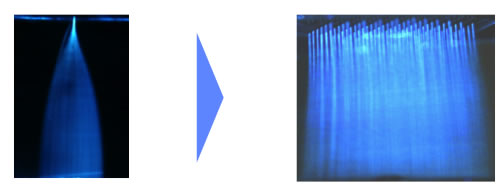 |
Left: image of single electrospray. Right: image of multiplexed electrospray system generating droplets of uniform size. |
RECENTLY COMPLETED PROJECTS
Materials Synthesis for Solar Energy Harvesting and Energy Storage (NSF sponsored)
The search for new nanomaterials with the right physical and chemical properties for energy applications is very intense and is likely to play an ever increasing role as alternatives to fossil fuels become ever more urgent. Much less effort is being put in the pursuit of optimal manufacturing of these newly discovered materials. We are working to fill this niche by investigating novel approaches to the manufacturing of thin films of nanomaterials for energy applications using multiplexed ESs. Specifically, we are developing a well-controlled but inexpensive synthesis and a deposition process of nanoparticles, optimizing it, verifying improvements in the performances of energy system prototypes, and demonstrating feasibility of scale up. The electrospray disperses a suitable liquid precursor or a particle suspension into droplets that are either dried in their flight to the deposit area or undergo chemical reaction (pyrolysis) in a furnace before being collected on a deposit. Two proof-of-concept applications were considered: the synthesis of porous deposits for dye-sensitized solar cells and the fabrication of a Li-ion electrode for high energy density battery developments. In the first application, charged droplets were generated, carrying TiO2 nanoparticles, and deposited using an electric field. We showed how morphology, structure and performance of the resulting films can be controlled by varying: a) nanoparticle loading in the solvent suspension and, consequently, the size of the nanoparticle clusters, b) droplet evaporation rate before impact on the substrate and, consequently, contact of the clusters, and c) film density. We demonstrated examples in which the film structure affected device performance and used electrochemical impedance spectroscopy to rationalize our findings in terms of changes to electrical properties, namely resistance and capacitance, of the electrosprayed cells.
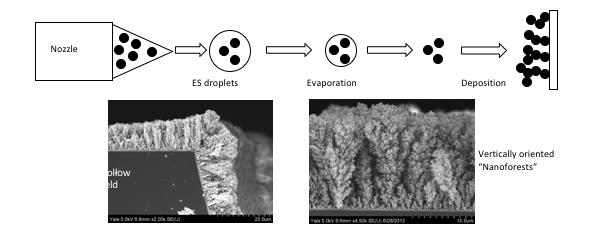 |
Top:schematic of the electrospray deposition of a porous nanoparticle film; SEM of deposited films. Electrostatics, particle concentration and droplet size, as well as droplet evaporation are operational parameters that can be used to manipulate film morphology. |
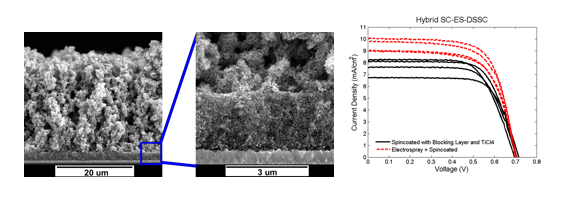 |
Cross-section of hybrid spincoated-electrosprayed dye sensitized solar cell left, with denser spincoated bottom section on the right. Right graph: current versus voltage performance of the cell (red lines) as compared to conventional spincoated cells (black lines). |
In the second application, we developed an approach that uses two electrosprays of opposite polarities to attain a controllable and scalable method for synthesizing nanoparticles with precise control over size, composition, shape, and morphology. It relies on electrospray pyrolysis in which charged, uniform sized liquid precursor droplets are first generated, then electrically neutralized by a second ES of opposite polarity and finally carried through a furnace for the synthesis of the desired nanoparticle, with each droplet serving as a nanoreactor in an environment of independently controlled temperature and residence time. We applied the approach to metal nitrates and synthesized a variety of metal oxides and mixed metal oxides, carbon coated nanoparticles, and hybrid structures of metal oxide-decorated graphene. In a proof-of-concept demonstration of inexpensive scale-up of the technique, we synthesized metal oxides using an array of ESs operating in parallel and a corona discharge to neutralize them. We then investigated the synthesis of a Mn3O4-graphene hybrid nanomaterial and tested it in a Li-Ion battery, verifying improvements in performance by comparison with alternative manufacturing techniques. The research activity was disseminated through three conference presentations and four peer-reviewed articles, all acknowledging NSF support. The work has the potential to streamline energy material fabrication resulting in substantial cost reduction in a continuous flow process. The approach is versatile and adaptable to new materials in the rapidly evolving field of nanotechnology, beyond the specific examples that were contemplated in the present project. The developed platform will be useful also in other energy applications, including supercapacitors and technologies for hydrogen production and fuel synthesis, as well as thin film sensors and applications of heterogeneous chemical catalysis and biomaterials.
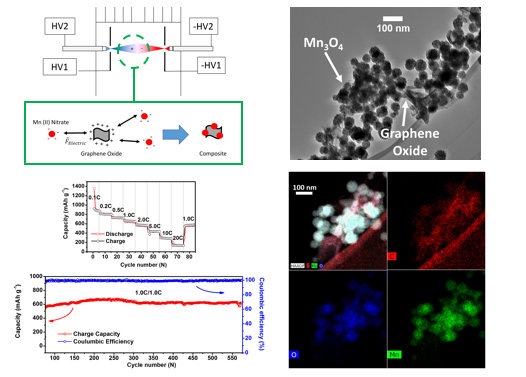 |
Top left: schematic of an electrospray pyrolysis system to yield the manganese oxide-manganese oxide-graphene oxide hybrid (TEM image at the top right). Bottom right: EDS (energy dispersive x-ray) of hybrid evidencing color coded atomic constituents. Bottom left: battery performance graphs showing good stability for >550 cycles, capacity at low charge/discharge rate near theoretical maximum (936 mAh/g) and good rate capability (capacity retention at high rates). |
Synthesis of Drug/Polymer Micro-(Nano-)particles for Controlled/Targeted Release (NSF sponsored)
We have been working on a well-controlled method to generate active agent/polymer micro-(nano-)particles of different morphologies for controlled/targeted drug release using the electrospray drying route. By judiciously selecting polymer molecular weight, concentration, and solution flow rate, we can control not only the size but also the morphology of the resulting polymer relics. We can generate either spherical, monodisperse particles or tailed and elongated particles at the microscale, as well as monodisperse nanoparticles. Experiments on the drug release rate of such particles, in collaboration with the group of Professor Tarek Fahmi at Yale, revealed that in a single-step flow process particles can be made to encapsulate the agent with high (>94%) efficiency and be coated with emulsifiers that either stabilizes their suspension in solution or facilitate further functionalization for targeted drug delivery. Importantly, throughout these studies efforts were made to establish fundamental criteria that would allow for the generation of particles of prescribed size, morphology and consistency from first principles. As a result, the extension of the approach to different drug/polymer combinations should be facilitated. The coupling of cone-jet ES and thermally induced phase separation was studied in collaboration with Dr. Richard Day at University College London.
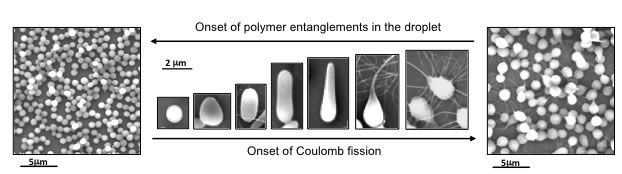 |
Particle morphology can be controlled by the competition between polymer chain entanglements, leading to spherical particles (left) and Coulomb fission, yielding “tailed” particles (right), with polymer volume fraction and solution flow rate as controlling variables. |
Electric Propulsion using Multiplexed Electrosprays of Ionic Liquids (AFOSR
sponsored)
In collaboration with the group of Professor J. F. de la Mora at Yale, we developed a single-propellant ES microthruster capable of covering a wide range of specific impulse (O(1000) s) and thrust (O(100) microN). It relies on the versatility of the ES with respect to changing droplet size and emitted current, and, as a result, mass-over-charge m/q, by varying liquid flow rate and physical properties. It includes a proof-of concept demonstration of multiplexing to provide sufficient trust for space applications.The focus of the project was the design, fabrication and testing of Multiplexed Electrosprays (MES) devices with up to 91 capillaries. The MES device consisted of a planar array of emitters, an extractor consisting of a perforated plate, and an accelerator electrode, with the dual function of containing the beam opening and improving the system propulsive performance. Uniformity of operation of all emitters was achieved by ensuring that the viscous pressure drop dominated over the electrodynamic pull at the capillary, which necessitated the increase of the hydraulic impedance of the system, by packing each nozzle with silica microbeads. This project is currently completed and will be continued if additional funding is available. Additional microfabrication design should be focused on increasing the MES hydraulic impedance, circumventing the need for microbeads and the unreliability of their filling process. Once such a development is realized, it would usher in a MES device for versatile in-space maneuvering of low- mass and power satellites through an additional one order of magnitude scaleup.
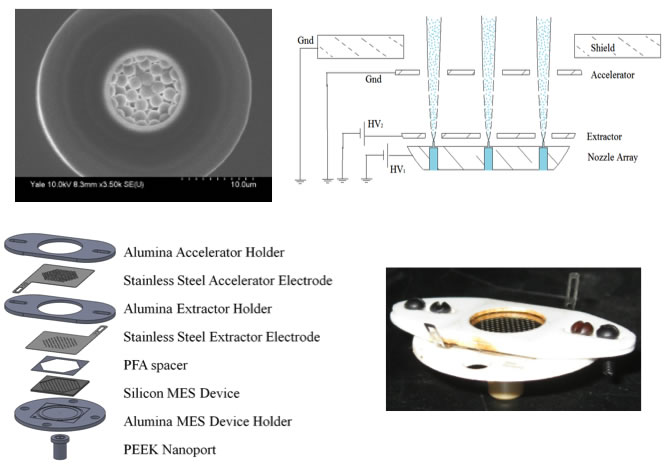 |
Top: left- SEM picture of an individual nozzle filled with microbeads; right- electrode configuration. Bottom: left- exploded view of packaging; right: picture of fully assembled device operated at 7 kV using ethylammonium nitrate as propellant, with thrust covering the 7.3-31 uN range and specific impulse covering the 1870-710 s range. |
Whirl Cook-Stove (internally sponsored)
There has been a frenzy of announcements recently on clean-burning cook-stoves including the establishment of an X-prize on the topic and of a Global Alliance for Clean Cookstoves. Cook-stoves are responsible for indoor smoke and the associated acute respiratory infections, accounting for 22% of all communicable child deaths in developing countries. Women who cook and the infants and children they care for are particularly affected. The fundamental cause of health and environmental problems are the poor mixing of the fuel and air and short residence time in the combustion chamber. By keeping combustion intermediates and the oxidizer segregated, pockets of fuel rich intermediates develop that eventually lead to the formation of soot, also referred to as particulate or black carbon. The soot, if air mixing and residence time are inadequate, is not burned off before being released from the stove. As a result of incomplete combustion, there are large emissions of non-CO2 green house gases (GHG) and soot per unit of heat released.We developed a simple cook-stove combustion technology that is well suited for biomass fuels and that ultimately may result in a very affordable device, at a cost on the order of 10USD. Cook-stoves are typically designed as a variation of the rocket-stove design, in which air is drawn through a single opening at the bottom of the stove by the chimney effect. The new concept is based on a modification of the entrainment geometry based on the establishment of a whirl, in which air is introduced tangentially in the combustion chamber and the biomass fuel is positioned strategically with respect to the air inlets. This in turn creates some recirculation and a distribution of pressure that is conducive to better mixing between fuel and oxidizer, more uniform burning and a reduction of pollutant emission. Thus, strategically positioned slits along the outer walls of the cook-stove serve the purpose of providing a passive entrainment without the need of a potentially unaffordable auxiliary fan. Water boiling tests revealed specific improvements with respect to the conventional natural-draft design, the so-called rocket stove, including: a 13% average increase in the thermal efficiency and a decrease in total particulate emissions of 53%. In water simmering tests, the gain in thermal efficiency is estimated at 24% and the reduction in particulate mass and number are 70% and 44%, respectively, as compared with the rocket mode. The particle abatement is more significant for sizes larger than 0.5um, with further benefits from the standpoint of aerosol penetration deep into the lungs. The whirl configuration ultimately may result in inexpensive manufacturing by casting the stove using an inexpensive mold. Limited field testing to optimize the design further was conducted in Bangladesh in the Spring 2011 in collaboration with BRAC.
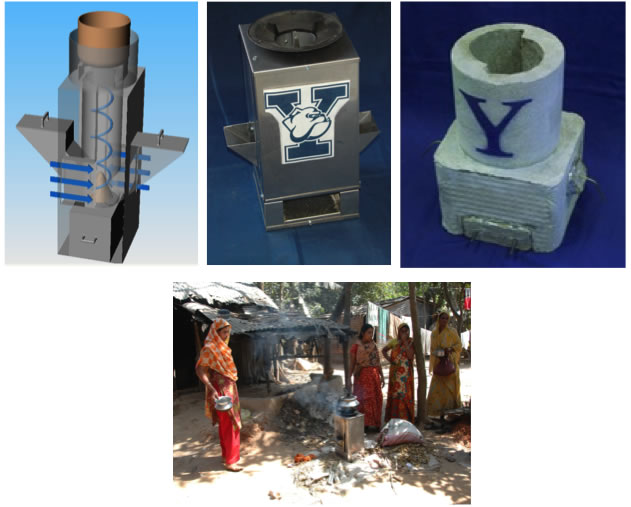 |
Top: Left- schematic of the whirl stove with blue arrows showing tangential air intake; middle- 1st generation metal prototype; right- 2nd generation stove in high-temperature cement realized with an inexpensive mold approach. Bottom: field testing in Bangladesh. |

School of Engineering & Applied Science
Center for Combustion Studies
Yale University |


